A white wall. A spray can. A provocative message. Socially conscious street art wasn’t born in galleries or boardrooms. It was born on the street, where everyone passes by and no one can look away. Yet this movement has evolved significantly. Today, local governments and companies commission socially conscious murals to embody their values in the physical space. So: what is socially conscious street art, what themes does it address, and how can you turn it into a concrete tool for your organization? Here’s an overview.

Summary
What exactly is socially conscious street art?
An artistic practice rooted in reality
Socially conscious street art is not merely decorative wall art without purpose. It encompasses all forms of urban art that convey a social, political, or environmental message. Every murals, every stencil, and every installation seeks to raise awareness among passersby and transform an ordinary wall into a public forum.
This movement is part of a long tradition: art as a tool for protest and social change. From cave paintings to the posters of May 1968, people have always used whatever surfaces were available to express their beliefs. The wall, accessible to all, thus remains the quintessential democratic medium.
From Clandestine Graffiti to murals : The Evolution of a Medium
Around the 1970s and 1980s, New York graffiti emerged in the underprivileged neighborhoods of the Bronx. It was clandestine, protest-driven, and often illegal. Artists signed their names to assert their presence in a public space that ignored them.
The 1990s saw the emergence of street art as we know it today: stencils, stickers, and large-scale murals. The message took precedence over the signature. Banksy, JR, and Shepard Fairey transformed the streets into a global stage. The shift was profound: we moved from transgressive acts to works deliberately crafted to provoke thought.
Today, institutions, brands, and city governments are funding socially conscious murals. After all, the authenticity of a murals is often worth more than years of corporate communications.
+40% Increase in orders for murals placed by public and private entities in France between 2019 and 2024.
The themes that make the walls shake
Ecology: The Climate Emergency in Large Format
The environment has become the dominant theme in contemporary socially conscious street art. From disappearing forests to endangered species painted on a large scale across entire building facades, artists are able to visually convey what statistics and scientific reports fail to convey emotionally.
Groups such as Extinction Rebellion have made urban art a central part of their communication strategy. Yet murals go beyond mere activism: they can also give tangible form to a community’s or a company’s concrete commitments to sustainable development, making them visible and tangible.
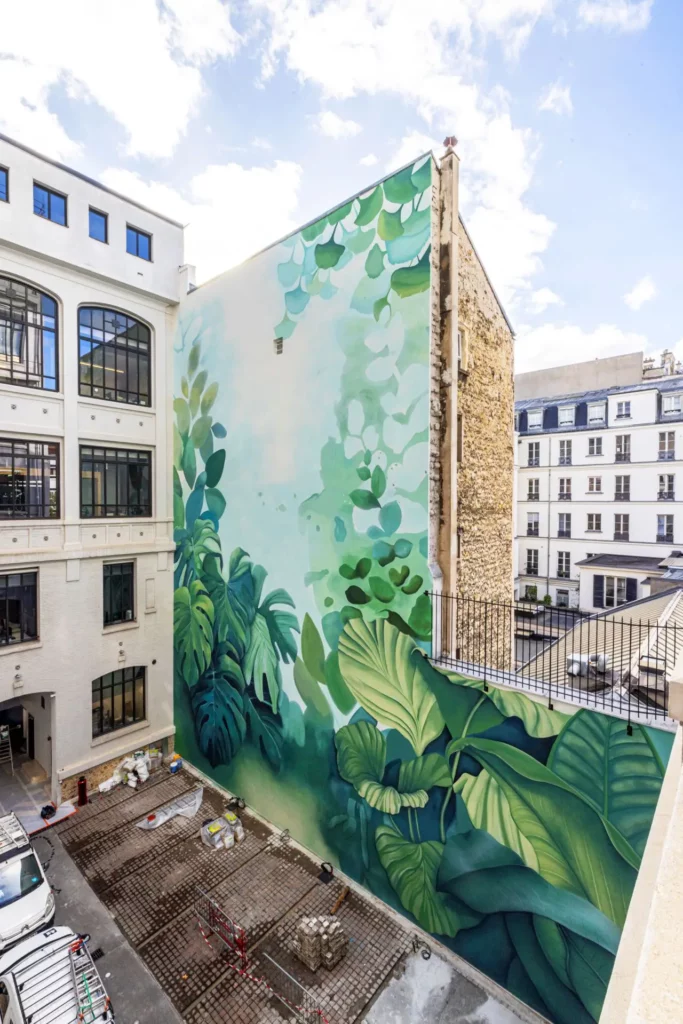
See also: Hand-painted plant murals
Social Justice, Diversity, Inclusion
The representation of minorities, the fight against discrimination, and gender equality: these topics are increasingly featured on the walls of cities across France and Europe. A murals to diversity in a public space or a corporate lobby is not merely an aesthetic gesture. It anchors a value in the physical space—permanently and visibly for all to see.
That is precisely why many organizations with a strong CSR culture turn to specialized agencies like PALM. The murals a concrete commitment, not just a statement of intent.

Local Memory and Territorial Identity
As a result, communities use street art to tell the story of a neighborhood, honor local figures, or celebrate a specific cultural identity. These works create a strong and lasting sense of belonging. In particular, they speak to residents in their own visual language, rooted in their local area and their collective memory.
A well-designed murals can revitalize an entire neighborhood, attract visitors, and foster a sense of local pride. That is why it is a long-term cultural investment, the return on which far exceeds the cost of creation.

Must-see: Gradignan X Nawel Boussouri – murals Saint-Gery
The Artists Who Changed Everything
It is impossible to discuss socially conscious street art without mentioning the figures who defined the movement and gave it international legitimacy.
Banksy: Anonymity in the Service of the Message
The British artist, whose identity remains unknown, is the ultimate symbol of socially conscious street art. His ironic stencils denounce war, capitalism, and mass surveillance with formidable effectiveness. Every time a new Banksy piece appears, it generates global media coverage—proof that urban art can have an impact as powerful as any multi-million-euro advertising campaign.

JR: The Faces of the Forgotten on the Facades of the World
French photographer and visual artist JR pastes giant portraits of ordinary people onto buildings, bridges, and dividing walls. His “Inside Out” project has involved more than a million participants in 130 countries. JR demonstrates that socially conscious street art can be participatory and deeply unifying, going far beyond mere provocation.

French artists with a social conscience to follow
In France, artists such as Kashink, Inti, and the talents of the PALM network are bringing socially conscious street art to large-scale murals. They regularly collaborate with city governments, public housing organizations, and businesses to create custom works that are both visually striking and deeply meaningful.
Why Businesses and Local Governments Are Embracing It
A communication tool that strikes the right note
The public—citizens, consumers, and employees—have become experts at spotting insincerity. A corporate poster on sustainable development leaves little of an impression. A large murals , created by a socially conscious artist in a public space, in collaboration with residents or local teams—that’s a whole different story.
Social-conscious urban art thus serves as tangible evidence of commitment. It is not consumed on a screen but becomes part of the everyday landscape for residents and employees, and its impact is measured over the long term.

Must-see: Renault X Cléon X Naïf – School Safety by Art
Urban Art and Corporate Social Responsibility: A Meaningful Partnership
An organization’s CSR strategy gains credibility when it is visually embodied in the physical world. A murals to biodiversity on the facade of a corporate headquarters is not merely an aesthetic gesture: it is a visible symbol of the company’s culture, aimed at employees, local residents, and partners alike.
Wall murals also often involve a collaborative process with artists and local stakeholders. This process itself generates content and engagement on social media, and strengthens ties with the local community.
Take Action: Order a murals
Commissioning a murals isn’t something you can just wing. In fact, it requires a detailed brief, selecting an artist whose approach aligns with the message, and careful consideration of technical constraints: the surface, weather conditions, and administrative permits.
That’s why at PALM, we support businesses and local governments every step of the way, from the creative brief to final delivery.
- See our murals.
- Our selection of murals .
FAQ: The Questions We're Asked Most Often
Graffiti originally referred to writing or drawings scrawled on a public surface, often illegally. Street art, on the other hand, is a broader term that encompasses all forms of artistic expression in public spaces, including commissioned murals. It specifically conveys a message with social, political, or environmental implications.
No. A message can indeed be social, environmental, or cultural without being partisan. That is why many organizations commission murals that address issues reflecting their values without taking a stance on the political spectrum.
The choice of artist is crucial. Indeed, the artist’s personal approach must align with the message you wish to convey: an artist whose work addresses environmental issues will be a better fit for an murals than a general illustrator. PALM will guide you through this selection process based on your brief and budget.
See also